


Prayer is the cornerstone of Muslim life, and for the millions of Muslims living in and visiting Qatar, knowing the accurate prayer times is an essential part of daily routine. Whether you are a resident of Doha, Al Wakrah, Al Khor, or Al Rayyan, staying aligned with the five daily prayers keeps you spiritually grounded and connected to your faith.
This comprehensive guide covers everything you need to know about Qatar prayer time, Namaz time in Qatar, and how to find accurate timings across every major city in the country.
Today’s Prayer Time in Qatar
Knowing today’s exact Namaz time is one of the most important parts of a Muslim’s daily routine in Qatar. Below you will find the complete and accurate prayer times for Sunday, June 28, 2026 (13 Muharram 1448 AH) for Doha, Al Wakrah, Al Khor, and Al Rayyan. All times are calculated using the official Qatar calculation method (Fajr 18°, Isha 90 minutes after Maghrib) as used by the Ministry of Awqaf and Islamic Affairs, Qatar Standard Time (AST, UTC+3).
Note: Prayer times shift daily. Always verify your local mosque’s Jamaat (congregation) time, as it may differ by a few minutes from the Adhan time listed below.
Prayer Times in Doha Today
Doha is the capital of Qatar and serves as the national reference point for prayer time calculations. Its coordinates are 25.2854° N, 51.5310° E.
Today’s prayer times in Doha are as follows: Fajr at 3:14 AM, Sunrise at 4:45 AM, Dhuhr at 11:37 AM, Asr at 3:00 PM, Maghrib at 6:29 PM, and Isha at 7:59 PM.
Fajr — 3:14 AM
Sunrise — 4:45 AM
Dhuhr — 11:37 AM
Asr — 3:00 PM
Maghrib — 6:29 PM
Isha — 7:59 PM
Doha is currently in the heart of summer, which means Fajr arrives in the very early hours of the morning and Isha does not begin until the evening sky has fully darkened. The gap between Fajr and Sunrise is approximately one hour and thirty-one minutes, giving worshippers a comfortable window for the morning prayer. The fasting window today, from Fajr to Maghrib, spans approximately fifteen hours and fifteen minutes.
Prayer Times in Al Wakrah Today
Al Wakrah is located approximately 15 kilometers south of Doha along the eastern coast. Being on nearly the same longitude as Doha, its prayer times are extremely close to the capital’s schedule, with differences of less than one minute in most prayers.
Today’s prayer times in Al Wakrah are: Fajr at 3:14 AM, Dhuhr at 11:37 AM, Asr at 2:59 PM, Maghrib at 6:28 PM, and Isha at 7:58 PM.
Fajr — 3:14 AM
Sunrise — 4:45 AM
Dhuhr — 11:37 AM
Asr — 2:59 PM
Maghrib — 6:28 PM
Isha — 7:58 PM
Al Wakrah is one of Qatar’s oldest towns and has a rich Islamic heritage. Its mosques are well-established and serve a large residential community. Today’s Maghrib in Al Wakrah is one minute earlier than Doha, which reflects its very slightly more southerly position. Residents of Al Wakrah and nearby Mesaieed can comfortably follow these timings for all five daily prayers.
Prayer Times in Al Khor Today
Al Khor, known officially as Al Khawr, is situated on the northeastern coast of Qatar approximately 60 kilometers north of Doha. Its coordinates place it at a slightly different position from Doha, which results in minor but notable differences in prayer times, particularly for Fajr.
Today’s prayer times in Al Khor are: Fajr at 3:11 AM, Dhuhr at 11:36 AM, Asr at 3:00 PM, Maghrib at 6:28 PM, and Isha at 7:58 PM.
Fajr — 3:11 AM
Sunrise — 4:42 AM
Dhuhr — 11:36 AM
Asr — 3:00 PM
Maghrib — 6:28 PM
Isha — 7:58 PM
Al Khor residents will notice that Fajr today is three minutes earlier than in Doha, which is consistent with its more northerly and slightly more easterly position. This means the pre-dawn meal (Suhoor) must be completed slightly earlier for those fasting. Al Khor is home to a large South Asian workforce and has numerous mosques catering to diverse Muslim communities. The industrial areas of Ras Laffan, just north of Al Khor, follow timings very close to those listed above.
Prayer Times in Al Rayyan Today
Al Rayyan is Qatar’s second largest municipality by population and covers a large area to the west and southwest of Doha. Because it extends westward, its prayer times are slightly later than central Doha, as the sun reaches Al Rayyan after it passes Doha.
Today’s prayer times in Al Rayyan are: Fajr at approximately 3:15 AM, Dhuhr at 11:33 AM, Asr at 2:57 PM, Maghrib at 6:22 PM, and Isha at 7:52 PM.
Fajr — 3:15 AM
Sunrise — 4:43 AM
Dhuhr — 11:33 AM
Asr — 2:57 PM
Maghrib — 6:22 PM
Isha — 7:52 PM
Al Rayyan’s Maghrib today is notably about seven minutes earlier than Doha’s, which reflects the different calculation coordinates used for this sprawling western municipality. Residents of Al Rayyan, which includes areas such as Education City, Al Luqta, Muaither, and Abu Hamour, should use these city-specific timings rather than relying on Doha’s schedule for the most precise observance.
Quick Comparison: All Five Prayers Across Qatar Cities Today (June 28, 2026)
Here is a side-by-side reference of today’s prayer times across all four major cities for easy comparison:
Prayer | Doha | Al Wakrah | Al Khor | Al Rayyan
Fajr | 3:14 AM | 3:14 AM | 3:11 AM | 3:15 AM
Dhuhr | 11:37 AM | 11:37 AM | 11:36 AM | 11:33 AM
Asr | 3:00 PM | 2:59 PM | 3:00 PM | 2:57 PM
Maghrib | 6:29 PM | 6:28 PM | 6:28 PM | 6:22 PM
Isha | 7:59 PM | 7:58 PM | 7:58 PM | 7:52 PM
All times are in Qatar Standard Time (AST, UTC+3). Times are calculated using the Qatar Ministry of Awqaf method. Individual mosque Jamaat times may vary by a few minutes. Always confirm with your local mosque for congregational prayer schedules.
Understanding Prayer Times and Namaz Times in Qatar
Qatar is a deeply Islamic nation where faith shapes the rhythm of daily life. The call to prayer echoes across the country five times a day, from the early hours before sunrise to the quiet of the night. Prayer times, also known as Namaz times, are not fixed clock times. They shift every single day based on the position of the sun, the season, and the geographic location of the worshipper.
In Qatar, prayer times are officially regulated and announced by the Ministry of Awqaf and Islamic Affairs. The country follows a unified prayer time schedule that accounts for its geographic position in the Arabian Gulf region, sitting at approximately 25 degrees north latitude and 51 degrees east longitude.
Understanding these times is important not just for practicing Muslims but also for businesses, government offices, schools, and anyone living or working in Qatar. The country pauses for prayer, and being aware of Namaz times allows you to plan your day respectfully and efficiently.
Qatar’s prayer times change gradually throughout the year. In summer, Fajr arrives very early and Isha comes late in the evening. In winter, the schedule shifts considerably, with Fajr coming later and Maghrib arriving in the late afternoon. The differences between cities like Doha, Al Khor, Al Wakrah, and Al Rayyan are relatively small, usually no more than a few minutes, but they are worth knowing for precise observance.
Fajr Prayer Time in Qatar
Fajr is the first prayer of the day and is performed before sunrise. It is one of the most spiritually significant prayers in Islam, representing the start of a new day with remembrance of ALLAH. In Qatar, Fajr time begins at the break of dawn, known as Subh Sadiq, when the first light appears on the eastern horizon.
In Doha, Fajr time varies significantly across the year. During winter months such as December and January, Fajr begins at approximately 5:15 AM to 5:30 AM. During summer months such as June and July, Fajr can be as early as 3:30 AM to 3:45 AM.
Fajr has two units of prayer (Rakat) and is preceded by the Adhan (call to prayer) and the Iqama. Many mosques in Qatar broadcast the Fajr Adhan with a distinctive, quieter tone out of respect for those who are still sleeping.
For residents of Al Rayyan, which sits slightly west of Doha, Fajr time may be approximately one to two minutes later than central Doha. Al Khor, located to the north, sees Fajr at times very close to Doha’s schedule. Al Wakrah, to the south of Doha, also follows a schedule within one to two minutes of the capital’s timings.
Dhuhr Namaz Time in Qatar
Dhuhr is the second prayer of the day and is performed after the sun has passed its highest point in the sky, which is local solar noon. In Qatar, Dhuhr time typically falls between 11:30 AM and 12:15 PM during winter, and between 12:00 PM and 12:30 PM during summer.
This is perhaps the most visible prayer in Qatar’s daily public life. Government offices, shopping malls, restaurants, and many businesses pause operations during Dhuhr prayer. Many workers use their lunch break to perform Dhuhr, and mosques across Doha, Al Wakrah, Al Khor, and Al Rayyan fill up significantly at this time.
Dhuhr consists of four Rakat and is considered a Fardh (obligatory) prayer. On Fridays, Dhuhr is replaced by the Jumu’ah (Friday) prayer, which carries special significance in the Islamic week.
Asr Prayer Time in Qatar
Asr is the third prayer and is performed in the afternoon. Its timing is calculated based on the length of shadows, and there are two schools of thought regarding when exactly Asr begins. The Shafi’i, Maliki, and Hanbali schools calculate Asr when an object’s shadow equals its own height plus the shadow length at noon. The Hanafi school uses twice the object’s height as the measure.
In Qatar, the official prayer time schedule generally follows the calculation used by the majority of Gulf countries, which aligns with the earlier Asr time.
In Doha, Asr time during winter months falls around 3:00 PM to 3:30 PM. During summer, Asr can be as late as 3:45 PM to 4:15 PM. This is another prayer during which many offices and shops in Qatar take a short break, and it is common to see mosques filling up across all cities in the country.
Maghrib Prayer Time in Qatar
Maghrib is the fourth prayer and is performed immediately after sunset. It is one of the shortest prayers in terms of time window, as it must be completed before the onset of Isha. In Qatar, the window between Maghrib and Isha is typically about an hour and a half.
Maghrib time in Doha during winter months falls around 5:15 PM to 5:30 PM. In summer, Maghrib can be as late as 7:00 PM to 7:15 PM due to Qatar’s long summer days. This prayer consists of three Rakat and is a particularly beautiful time to pray, as the sky transitions from golden to deep blue.
Maghrib is often considered one of the most communal prayers in Qatar. Many families gather to break their fast during Ramadan right at Maghrib time, and mosques host Iftar gatherings that are open to Muslims and non-Muslims alike.
Isha Namaz Time in Qatar
Isha is the fifth and final obligatory prayer of the day. It is performed after the red twilight in the sky has completely disappeared, which generally means about 90 minutes after Maghrib in Qatar’s geographic location.
In Doha, Isha time during winter months falls around 7:00 PM to 7:30 PM. During summer, Isha can be as late as 9:00 PM to 9:15 PM. This prayer consists of four Rakat and marks the close of the day’s obligatory worship.
Many Muslims in Qatar also perform the optional Witr prayer after Isha, especially during Ramadan when Tarawih prayers are also added to the night schedule. Mosques across Doha, Al Rayyan, Al Wakrah, and Al Khor often remain active late into the night during Ramadan for these additional prayers.
Juma Time Qatar
Jumu’ah, commonly known as the Friday prayer, is the most important congregational prayer of the week in Islam. It replaces the Dhuhr prayer on Fridays and is obligatory for adult Muslim men. Attending Jumu’ah at a mosque is a religious duty, and the sermon (Khutbah) delivered before the prayer is an important part of community life.
In Qatar, Jumu’ah time is officially set by the Ministry of Awqaf and Islamic Affairs and is generally consistent across the country. The Khutbah typically begins around 11:45 AM to 12:00 PM, and the prayer itself follows shortly after, usually concluding by 12:30 PM to 12:45 PM. These timings shift slightly throughout the year.
All major mosques in Doha, including the State Grand Mosque (Imam Muhammad ibn Abd al-Wahhab Mosque), as well as mosques across Al Rayyan, Al Wakrah, Al Khor, and other areas, hold Jumu’ah prayers. The Khutbah in Qatar is delivered in Arabic, though many mosques with diverse international congregations may provide translations or hold supplementary Friday gatherings.
Friday is a public holiday in Qatar, and the entire country observes a more relaxed pace in the morning with the Jumu’ah prayer serving as the anchor of the day.
How Prayer Times Are Calculated in Qatar
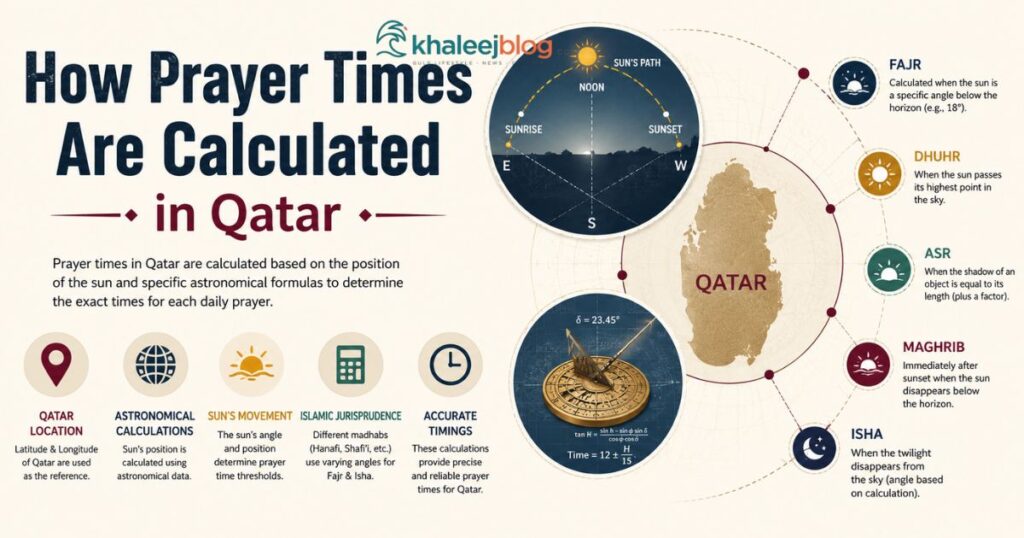
Prayer times in Qatar are not arbitrary. They are based on precise astronomical calculations that have been refined over centuries of Islamic scholarship. The Ministry of Awqaf and Islamic Affairs in Qatar oversees the official prayer timetable, which is published annually.
The key parameters used for calculating Qatar prayer times include:
The geographic coordinates of Qatar, particularly Doha, which serves as the reference point. The country uses a latitude of approximately 25.29 degrees north and longitude of 51.53 degrees east for central calculations.
The calculation method used in Qatar follows the Umm al-Qura method, which is the standard used across much of the Gulf region and is based on the guidelines of the Muslim World League.
Fajr is calculated when the sun is 18 degrees below the horizon (astronomical twilight). Isha is similarly calculated when the sun reaches 17 to 18 degrees below the horizon in the evening. Dhuhr is calculated at true solar noon. Asr follows the Shafi’i standard, and Maghrib begins precisely at sunset.
Because Qatar is a small country geographically, the variation in prayer times between different cities is minimal but not negligible. Doha’s times serve as the national standard, and cities to the east see prayers slightly earlier while those to the west experience them slightly later.
Dukhan Prayer Time
Dukhan is an industrial city located on the western coast of Qatar, approximately 80 kilometers west of Doha. It is home to Qatar’s oil industry and has a significant residential community of workers and their families.
Because of its position significantly to the west of Doha, Dukhan’s prayer times are noticeably later than those of the capital. The time difference between Doha and Dukhan is approximately 3 to 5 minutes for each prayer. For example, if Maghrib in Doha is at 5:20 PM, it may be around 5:24 PM to 5:25 PM in Dukhan.
For residents and workers in Dukhan, it is important to use prayer time tools that allow for location-specific calculations rather than relying solely on Doha timings. Apps such as Muslim Pro, Athan Pro, and the official MEIA Qatar app provide city-specific times that account for Dukhan’s western coordinates.
Prayer Time in Ras Laffan Qatar
Ras Laffan is Qatar’s major industrial city located on the northeastern coast, approximately 80 kilometers north of Doha. It is home to one of the world’s largest liquefied natural gas (LNG) facilities and hosts a large international workforce.
Because Ras Laffan sits to the northeast of Doha, its prayer times are very slightly earlier than those of the capital, by approximately 1 to 2 minutes. While this difference may seem minor, it is important for strictly observant Muslims to use accurate, location-specific timings.
Workers in Ras Laffan have access to mosques within the industrial city, and prayer facilities are available across the complex to ensure workers can observe their religious obligations. The management of facilities in Ras Laffan is generally supportive of prayer time observance, consistent with Qatar’s broader national culture of accommodation for Islamic practice.
Lusail Prayer Time Today
Lusail is Qatar’s newest and most modern city, located just north of Doha. It gained international fame as the host city of the 2022 FIFA World Cup final, held at Lusail Stadium. Today, Lusail is a rapidly growing residential and commercial hub with a large and growing Muslim population.
Because Lusail sits just a few kilometers north of downtown Doha, its prayer times are essentially the same as Doha’s, with differences of less than a minute. For practical purposes, residents of Lusail can follow Doha’s official prayer times without any significant deviation.
Lusail has several mosques within its planned city layout, and new mosques continue to open as the city’s population grows. The city’s design incorporates Islamic architectural elements, and prayer facilities are integrated into commercial and residential zones.
Maghrib Time Mesaieed
Mesaieed, also known as Umm Said, is an industrial city located approximately 40 kilometers south of Doha along the eastern coast. It is home to petrochemical industries and has a significant residential population.
Because Mesaieed is to the south but on approximately the same longitude as Doha, its prayer times are very close to Doha’s, with differences of less than a minute for most prayers. Maghrib time in Mesaieed is essentially the same as in Doha, making it straightforward for residents to follow the national prayer timetable.
Mesaieed has mosques serving its community, and the city’s relatively close proximity to Doha means that residents can easily access both city resources for prayer time information.
Why Accurate Prayer Times Matter
Accuracy in prayer times is not merely a matter of convenience. In Islamic jurisprudence, performing a prayer outside its prescribed time window is considered a serious matter. A prayer performed before its time begins is invalid and must be repeated. A prayer performed after its time has ended without a valid excuse is considered a sin, even if it is made up later.
This is why millions of Muslims in Qatar rely on verified, precise prayer timetables rather than estimates or outdated schedules. The difference of even a few minutes can determine whether a prayer is valid.
For Muslims living in Qatar, accurate prayer times also help with planning work schedules, meetings, and social activities in a way that does not conflict with religious obligations. Qatar’s labor laws and cultural norms are supportive of prayer observance, but it remains the individual’s responsibility to know their prayer times and honor them.
For businesses operating in Qatar, awareness of prayer times is essential for smooth operations, customer relations, and respectful conduct in the workplace.
Prayer Times During Ramadan in Qatar
Ramadan is the holiest month in the Islamic calendar, and prayer in Qatar takes on an even more central role during this time. The daily schedule during Ramadan revolves around fasting from Fajr until Maghrib, and the night is filled with additional prayers and Quran recitation.
During Ramadan, the key prayer times become even more significant:
Suhoor is the pre-dawn meal, which must be completed before Fajr begins. Knowing the precise Fajr time is critical, as eating after Fajr invalidates the fast.
Iftar is the breaking of the fast at Maghrib. Mosques, hotels, and households across Qatar prepare elaborate Iftar meals, and the moment of Maghrib Adhan is one of the most anticipated moments of the day.
Tarawih prayers are special nightly prayers performed after Isha during Ramadan. They consist of 8 to 20 Rakat depending on the tradition being followed, and Qatar’s mosques hold large congregational Tarawih sessions that are deeply communal events.
Laylat al-Qadr, the Night of Power, falls in the last ten nights of Ramadan, with the 27th night being the most widely observed. Mosques in Qatar host all-night prayer vigils during these nights, and the spiritual atmosphere across the country is profound.
During Ramadan, Qatar’s official working hours are reduced, businesses adjust their schedules, and the entire rhythm of the country shifts to accommodate the demands of fasting and night worship.
Best Apps for Qatar Prayer Times
Technology has made it easier than ever for Muslims in Qatar to stay on top of their prayer schedule. Several highly rated apps provide accurate, location-specific prayer times for Doha and across Qatar.
Muslim Pro is one of the most popular apps globally and provides prayer times based on your exact GPS location. It uses multiple calculation methods and allows you to select the Umm al-Qura method used in Qatar. The app includes Adhan audio, Qibla direction, and Quran recitation.
Athan Pro by Islamic Finder is another highly rated option that provides city-specific prayer times for all areas of Qatar including Dukhan, Ras Laffan, Mesaieed, Al Khor, and Al Wakrah. It allows for customized Adhan sounds and offers a widget for your phone’s home screen.
The official Qatar MEIA app, provided by the Ministry of Awqaf and Islamic Affairs, offers the government-verified prayer timetable for Qatar. This is the most authoritative source for official prayer times in the country.
IslamicFinder.org is a website and app that provides location-based prayer times for any city in Qatar. You can download monthly or annual prayer timetables in PDF format for reference offline.
Qibla Compass apps are also useful for Muslims in Qatar who want to ensure they are facing the correct direction for prayer. In Doha, the Qibla direction is approximately 267 degrees, or nearly due west with a slight northern tilt.
Prayer Time Differences Across Qatar Cities
Qatar is a relatively small country, covering about 11,571 square kilometers, which means that prayer time differences between cities are small but do exist. Here is a general overview of how times vary:
Doha serves as the national reference point for prayer times. All other cities are calculated relative to Doha’s coordinates.
Al Khor, located about 60 kilometers north of Doha on the eastern coast, has prayer times that are almost identical to Doha, within one minute.
Al Wakrah, about 15 kilometers south of Doha, also has prayer times very close to Doha’s, with differences of less than one minute.
Al Rayyan, Qatar’s second largest municipality by population, sits to the west and southwest of Doha. Prayer times in Al Rayyan are approximately one to two minutes later than in central Doha.
Dukhan, on the far western coast, has the most significant time difference from Doha among populated areas, with prayer times being approximately 3 to 5 minutes later.
Ras Laffan in the northeast has times slightly earlier than Doha by about one to two minutes.
Mesaieed and Lusail have times essentially identical to Doha, given their proximity and similar longitude.
Finding Mosques in Qatar
Qatar has thousands of mosques spread across its cities, towns, and industrial areas. Every neighborhood in Doha, Al Rayyan, Al Wakrah, and Al Khor has at least one mosque within walking distance, and in densely populated areas, there may be several mosques per square kilometer.
The State Grand Mosque, officially named the Imam Muhammad ibn Abd al-Wahhab Mosque, is Qatar’s largest and most prominent mosque, located in Doha. It can accommodate up to 30,000 worshippers and features stunning traditional Islamic architecture. It is the destination for major religious events and is open to visitors outside of prayer times for educational tours.
Qatar’s mosques are managed by the Ministry of Awqaf and Islamic Affairs, which ensures they are properly staffed, maintained, and equipped for daily prayers. All mosques in Qatar provide separate prayer facilities for men and women.
For non-Muslim visitors who wish to visit a mosque in Qatar, the Katara Cultural Village mosque and the Education City mosque are among the most accessible and welcoming to visitors, though proper dress code and etiquette must be observed.
Google Maps is a practical tool for finding the nearest mosque wherever you are in Qatar, as virtually all mosques are listed with their addresses, prayer times, and photos.
Prayer Times Resources and Tools
Beyond apps and websites, Qatar offers several resources for staying informed about prayer times and Islamic calendar events.
The Ministry of Awqaf and Islamic Affairs website publishes the official annual prayer timetable for Qatar, which can be downloaded and printed for personal use.
Qatar’s television channels, including Al Jazeera and Qatar TV, display prayer times on screen at regular intervals throughout the day. This is a traditional and reliable way to stay informed without needing a smartphone.
Many hotels in Qatar provide prayer time cards in guest rooms, and hotel rooms are typically oriented with a Qibla indicator on the ceiling or a card showing the direction of Mecca.
Mosques themselves broadcast the Adhan over loudspeakers at each prayer time, which serves as a community-wide announcement that prayer time has arrived. In Qatar, the Adhan is broadcast clearly and can be heard throughout residential and commercial areas.
Shopping malls, government buildings, and many workplaces post daily prayer times on notice boards or digital screens as a service to Muslim visitors and employees.
Frequently Asked Questions About Qatar Prayer Times
Many people new to Qatar or visiting the country have common questions about prayer times and their impact on daily life.
How do prayer times affect business hours in Qatar? Most businesses remain open during prayer times, though some smaller shops may close briefly. Government offices and many traditional businesses may close for 15 to 30 minutes during Dhuhr and Asr prayers. Restaurants and cafes generally remain open, though in traditional areas some may dim their service.
Are prayer times the same every day in Qatar? No. Prayer times change every day based on the sun’s position. The changes are gradual, typically just one to two minutes per day, but they add up significantly over weeks and months.
What is the Qibla direction in Qatar? From Doha, the Qibla direction is approximately 267 degrees, which is nearly due west. Most prayer apps and compasses can automatically calculate this based on your location.
Is it acceptable to pray in public in Qatar? Yes. Qatar is highly respectful of public prayer, and you will often see people praying in parks, shopping areas, and open spaces. Designated prayer rooms are available in all major public buildings, shopping centers, and transport hubs.
Can non-Muslims visit mosques in Qatar? Yes, some mosques in Qatar are open to non-Muslim visitors outside of prayer times. Proper dress, respectful behavior, and removing shoes before entering are required.
Five Pillars of Islam and Prayer’s Importance
To understand why prayer times are taken so seriously in Qatar and across the Muslim world, it is essential to understand the foundational role of prayer in Islam.
Prayer, known as Salah or Namaz, is the second of the Five Pillars of Islam, following only the declaration of faith (Shahada). The Five Pillars are: Shahada (declaration of faith), Salah (prayer), Zakat (charitable giving), Sawm (fasting during Ramadan), and Hajj (pilgrimage to Mecca for those who are able).
The obligation to pray five times daily was established during the Prophet Muhammad (peace be upon him) Night Journey and Ascension to the heavens, known as Isra and Mi’raj. The Quran mentions prayer numerous times and emphasizes its importance as a direct connection between the believer and ALLAH.
Salah is described in Islamic teaching as the foundation of the religion, the first deed for which a person will be held accountable on the Day of Judgment, and the strongest deterrent against immoral behavior. The Quran states that prayer keeps one away from indecency and evil.
In Qatar, this deep theological understanding of prayer translates into a society that structures itself around Salah. The country’s laws, business culture, social norms, and built environment all reflect the centrality of prayer to Muslim life.
Preparing for Prayer in Qatar
Performing Salah correctly requires preparation, and for Muslims in Qatar, the infrastructure for this preparation is available virtually everywhere.
Wudu, the ritual ablution (washing), is required before prayer. Every mosque in Qatar has wudu facilities for both men and women. Shopping malls, airports, major office buildings, and public spaces also have designated wudu areas within their prayer rooms.
Prayer clothing should be clean and cover the required parts of the body. For men, this means covering at minimum from the navel to the knee, though full clothing is the norm. For women, prayer requires covering the entire body except the face and hands.
A prayer mat is commonly used by Muslims in Qatar, though it is not obligatory as long as the surface is clean. Prayer mats are widely available across Qatar in mosques, Islamic gift shops, and most home goods stores.
Knowing the Qibla direction is important. In Qatar, most prayer rooms, mosques, and hotels provide clear Qibla markers. Prayer apps on smartphones can also determine the direction automatically using GPS.
The Call to Prayer in Qatar
One of the most distinctive and beautiful aspects of life in Qatar is the Adhan, the call to prayer. Five times a day, muezzins at mosques across the country call out the Adhan, inviting Muslims to leave their worldly activities and turn their attention to prayer.
The Adhan in Qatar is broadcast from mosque minarets using speaker systems, and in populated areas, multiple Adhans from different mosques can often be heard layering over each other, creating a powerful communal soundscape.
The words of the Adhan declare the greatness of ALLAH, testify to the prophethood of Muhammad (peace be upon him), and call believers to prayer and to success. The Fajr Adhan includes an additional phrase unique to the morning call: “Prayer is better than sleep.”
In Qatar, the Adhan for each prayer is synchronized nationally based on the official prayer time announcement from the Ministry of Awqaf. This means that across the country, Adhans are heard at essentially the same time, creating a sense of national unity in worship.
Non-Muslims living in Qatar often mention the Adhan as one of the most memorable and culturally rich aspects of their experience in the country.
Living in Sync with Namaz Times
For Muslims living in Qatar, organizing daily life around the five prayers is not a burden but a spiritual framework that gives structure and meaning to the day. Each prayer marks a transition point: Fajr begins the day with gratitude, Dhuhr pauses the workday for reflection, Asr marks the afternoon shift, Maghrib closes the day’s light with thankfulness, and Isha ends the day in peace.
Expatriate Muslims from countries around the world who come to Qatar often find it easier to maintain their prayer practice here than in their home countries, because the entire social and professional environment is built to accommodate Salah.
For non-Muslim expatriates and visitors, understanding and respecting prayer times is an important part of integrating into Qatari society. Being aware of when prayers occur, respecting the Adhan, and planning meetings and activities with prayer times in mind are signs of cultural sensitivity that are deeply appreciated by Qatari hosts and colleagues.
Qatar’s national vision and cultural identity are deeply intertwined with Islamic values, and prayer times are one of the most visible and tangible expressions of this relationship between faith and daily life.
Qatar’s Diverse Muslim Community
Qatar’s Muslim community is one of the most diverse in the world. While the indigenous Qatari population follows the Hanbali school of Islamic jurisprudence, the country hosts a massive expatriate workforce representing dozens of nationalities and every major school of Islamic thought.
Muslims from South Asia (Pakistan, India, Bangladesh, Sri Lanka) who follow the Hanafi school make up one of the largest Muslim communities in Qatar. They may follow slightly different timings for Asr prayer based on the Hanafi calculation, which begins later than the Shafi’i calculation.
Muslims from Egypt, Jordan, Sudan, and other Arab countries follow the Maliki and Shafi’i schools. Muslims from Iran follow Shia jurisprudence, which has some differences in prayer practice and timing, particularly for combining prayers.
Despite these differences in school of thought and cultural background, all Muslim communities in Qatar observe the same five prayers and are guided by the national prayer timetable issued by the Ministry of Awqaf. Qatar’s mosques are generally welcoming to Muslims of all backgrounds, and the country fosters a spirit of Islamic brotherhood across nationalities and traditions.
This diversity makes Qatar’s Islamic community a microcosm of the global Muslim ummah, united by the call to prayer that rings out five times every day across this remarkable Gulf nation.
Frequently Asked Questions
What are today’s Fajr and Maghrib times in Doha?
Today’s Fajr in Doha is at 3:14 AM and Maghrib is at 6:29 PM. These times shift slightly every day based on the sun’s position.
Do prayer times differ between Doha, Al Wakrah, Al Khor, and Al Rayyan?
Yes, but the differences are small, usually between one to seven minutes. Al Rayyan shows the most variation due to its westerly location, while Al Wakrah and Al Khor are very close to Doha’s timings.
Which calculation method is used for Qatar prayer times?
Qatar follows the Umm al-Qura calculation method, officially adopted by the Ministry of Awqaf and Islamic Affairs, using Fajr at 18 degrees and Isha at 90 minutes after Maghrib.
What is the best app to check Qatar prayer times?
Muslim Pro and Athan Pro are among the most reliable apps for accurate, location-specific prayer times across all Qatar cities including Doha, Al Khor, Al Wakrah, and Al Rayyan.
Do prayer times change during Ramadan in Qatar?
Prayer times follow the same solar calculation throughout the year including Ramadan. However, Suhoor and Iftar timings become critically important during Ramadan, as they align precisely with Fajr and Maghrib respectively.
Conclusion
Qatar is a nation where faith and daily life are beautifully intertwined, and prayer times sit at the very heart of that relationship. Whether you are a longtime resident of Doha, a worker in Al Khor, a family in Al Rayyan, or a newcomer settling into Al Wakrah, the five daily prayers, Fajr, Dhuhr, Asr, Maghrib, and Isha, provide a spiritual rhythm that shapes every hour of the day.
Knowing your accurate Qatar prayer time is not just a religious obligation but a way of living with intention and mindfulness. The small differences in Namaz times across Qatar’s cities remind us that precision matters in worship, and using the correct city-specific timings ensures that every prayer is offered within its proper window as defined by Islamic jurisprudence.
May every Muslim in Qatar, from the bustling streets of Doha to the industrial cities of Ras Laffan and Dukhan, find ease in observing their prayers on time, every single day. And may those visiting or new to Qatar come to appreciate the profound beauty of a society that organizes itself around the remembrance of ALLAH.
More About NOW To Qatar Visit: KhaleejiBlog